
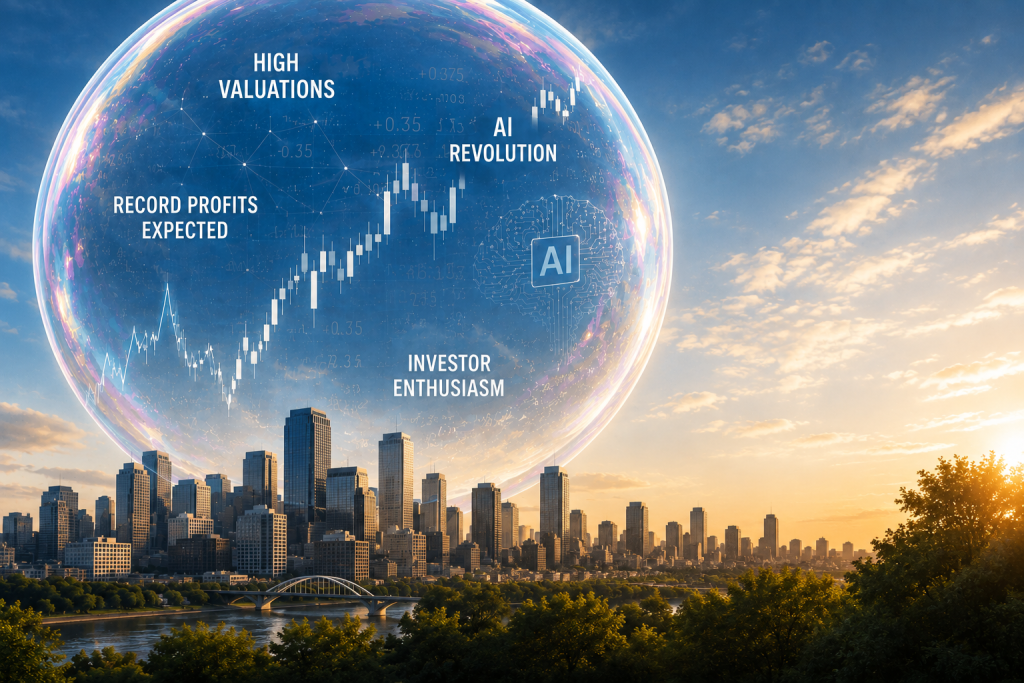
There are some pretty compelling reasons to believe parts of the U.S. stock market have become expensive.
By several commonly followed measures, valuations are at or near levels we’ve seen during some of history’s biggest market booms. The Shiller P/E ratio is around 41, compared with a long-term average closer to 17. The Buffett Indicator—which compares the value of the U.S. stock market with the size of the U.S. economy—is also sitting at historically elevated levels.
And behind much of the recent enthusiasm is a very real technological revolution: artificial intelligence.
I want to emphasize the word real.
AI could fundamentally reshape productivity, business and the economy over the coming decades. But history teaches us something important: a transformative technology and an overpriced investment are not mutually exclusive.
The railroad changed America. The internet changed the world. Both also produced enormous investment bubbles along the way.
That possibility is worth thinking about today.
The AI Boom Can’t Accelerate Forever
Technology companies are spending extraordinary amounts of money building data centers, buying advanced chips and developing AI infrastructure.
That spending has been wonderful for the companies supplying the proverbial “picks and shovels.” But markets don’t simply reward high levels of spending—they tend to reward continued growth.
Eventually, it becomes mathematically and practically difficult for investment to keep accelerating at the same pace. There are limits to electrical capacity, construction, chip production and corporate balance sheets.
When that happens, investors may begin asking a different question:
What return are companies actually earning on all this money they spent?
That’s where things can get interesting.
If revenue and profits don’t eventually justify the enormous amount of capital invested, expectations can change quickly. And expensive stocks don’t necessarily require terrible news to decline. Sometimes good results that aren’t quite as good as investors expected are enough.
Higher Interest Rates Matter Too
There is another piece of the equation that receives less attention.
Higher long-term interest rates create competition for stocks. When investors can earn meaningful returns from bonds and other relatively conservative investments, paying extremely high prices for future corporate earnings becomes less attractive.
At the same time, America’s growing federal debt creates additional uncertainty around long-term interest rates.
None of this means a market decline is imminent.
In fact, that’s one of the most important lessons from previous bubbles.
Being Early Can Look Exactly Like Being Wrong
Markets can remain expensive for a surprisingly long time.
During the technology bubble of the late 1990s, some very smart investors recognized the excess years before the market finally broke. In the meantime, stocks continued climbing and anyone who became defensive too early watched everyone else seemingly get richer.
That’s what makes bubbles so difficult.
You have to be right twice—when to get out and when to get back in.
That’s a game we aren’t particularly interested in playing.
Build the Plan So We Don’t Have to Predict the Future
I don’t know whether today’s market ultimately proves to be an AI bubble. I certainly don’t know when it will end if it is.
And thankfully, our financial plans shouldn’t require us to know.
For someone approaching or living in retirement, the better questions are different:
Do we have enough liquidity so we aren’t forced to sell investments during a significant downturn? Are we taking more market risk than our plan actually requires? Are our investments sufficiently diversified? Do we have dependable sources of income outside the stock market? And if stocks fell substantially tomorrow, would our financial plan still work?
Those are questions we can actually answer.
There will always be another economic forecast, another technological revolution and another reason why “this time is different.”
Sometimes it really is different.
But human behavior usually isn’t.
Our job isn’t to predict when the music stops. It’s to build a financial framework strong enough that we don’t have to.